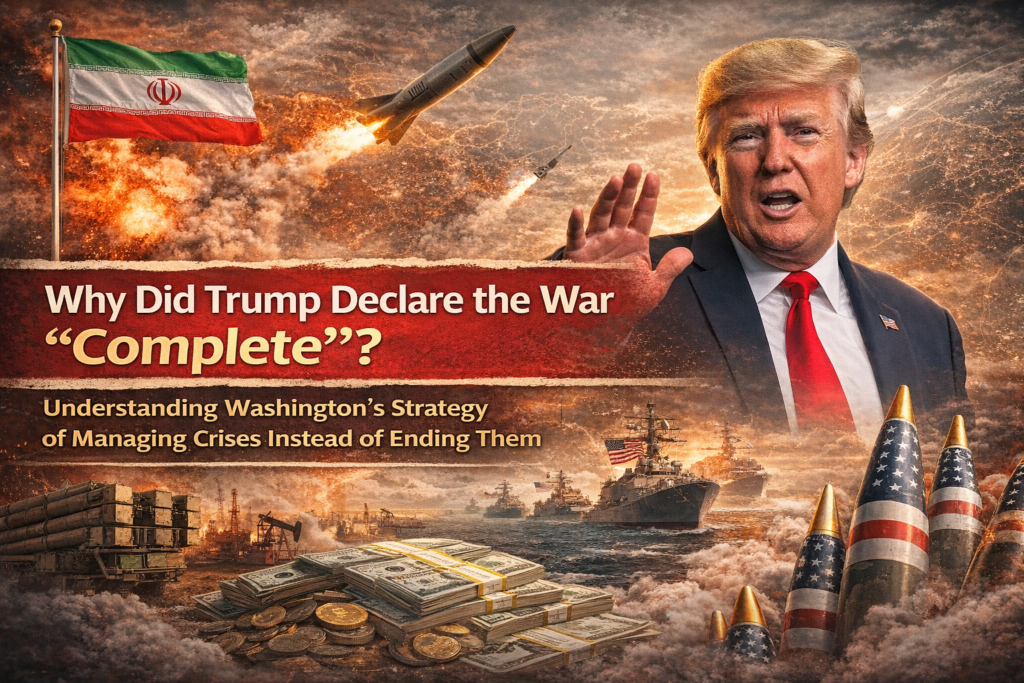

Understanding Washington’s Strategy of Managing Crises Instead of Ending Them
An in-depth geopolitical analysis exploring why Donald Trump declared the war “complete,” the role of defense spending, Iran’s strategic position, and the broader U.S.–China rivalry in the Middle East.
Introduction
Why would a major global power suddenly declare that a conflict is “complete” while the underlying tensions remain unresolved?
This question resurfaced after statements attributed to Donald Trump suggested that the war had effectively reached its conclusion—even though the political system and the broader geopolitical confrontation in the region remained intact.
For many analysts, such declarations are rarely simple military announcements. Instead, they often reflect strategic repositioning, where a conflict is not fully resolved but rather frozen, managed, or reshaped to serve broader geopolitical goals.
In this article, we will examine several possible strategic reasons behind such a move, including:
- The economic role of defense spending
- The strategic value of maintaining controlled tensions
- Competition with China for global influence
- The risks of a prolonged military confrontation
- How regional security dynamics influence U.S. policy
Strategic Freeze Instead of Military Victory
When leaders announce the end of a conflict without fundamentally changing the geopolitical landscape, analysts sometimes describe the situation as a “strategic freeze.”
This means that:
- The conflict stops escalating
- The main actors remain in place
- The underlying tensions continue
Such a strategy allows governments to avoid the costs of prolonged warfare while still maintaining leverage over regional dynamics.
In the case of tensions involving Iran, the geopolitical environment is particularly complex, involving multiple regional and global actors.
The Economic Dimension: Defense Spending and Security Markets
One factor frequently discussed in geopolitical analysis is the relationship between international tensions and the global defense industry.
The United States hosts many of the world’s largest defense companies, producing advanced military technologies such as:
- Missile defense systems
- Fighter aircraft
- Advanced radar systems
- Precision-guided weapons
When regional tensions rise, countries often increase defense spending to strengthen their security capabilities.
For example, many nations have invested in advanced air defense systems like:
- Patriot missile system
- THAAD
These systems are designed to intercept incoming ballistic missiles and protect strategic infrastructure.
Defense spending therefore becomes a major economic and strategic factor in international relations.
Controlled Threats and Strategic Balance
In geopolitical strategy, some analysts argue that states sometimes prefer manageable threats rather than unpredictable instability.
A controlled level of tension can serve several strategic functions:
- Encouraging military cooperation between allies
- Justifying the presence of foreign military bases
- Maintaining strategic influence in key regions
The Middle East has long been considered one of the world’s most strategically important regions because of its:
- Energy resources
- Geographic location
- Global trade routes
Maintaining influence in such a region is therefore a priority for many global powers.
The Global Competition with China
Another factor shaping U.S. strategy in the region is the rising global influence of China.
China has expanded its economic presence in the Middle East through:
- Infrastructure investments
- Energy partnerships
- Trade agreements
Programs such as the Belt and Road Initiative have strengthened China’s ties with several countries across Asia, Africa, and the Middle East.
From Washington’s perspective, geopolitical competition with China is now one of the central dynamics shaping global politics.
Maintaining strong strategic relationships in the Middle East therefore remains a major priority.
The Cost of a Full-Scale War
Large-scale military conflicts carry enormous risks and costs.
A prolonged war could lead to:
- Global energy market disruptions
- Higher oil prices
- Regional instability
- Economic consequences worldwide
Additionally, modern conflicts involve complex technologies such as:
- Drones
- ballistic missiles
- cyber warfare systems
These factors make escalation extremely unpredictable.
Because of these risks, governments sometimes seek limited confrontations followed by de-escalation.
Political Messaging and Domestic Considerations
Political leaders also communicate with domestic audiences when discussing war and peace.
Declaring victory or announcing the completion of military objectives can serve several purposes:
- Strengthening political narratives
- Demonstrating leadership
- Reassuring the public
In many cases, such announcements are part of a broader political strategy rather than a literal description of the battlefield situation.
The Future of Regional Security
The Middle East continues to experience rapid geopolitical shifts.
Several factors will shape the region’s future:
- Military technology developments
- Energy market transformations
- Global power competition
- Regional diplomacy efforts
Countries across the region are also exploring new partnerships and security arrangements that could redefine the balance of power.
Conclusion
Statements declaring the end of a conflict rarely tell the entire story.
In many cases, they reflect strategic repositioning rather than complete resolution.
The situation involving Iran, the United States, and regional actors demonstrates how modern geopolitics often revolves around managing tensions rather than eliminating them entirely.
Whether these strategies lead to long-term stability or continued cycles of crisis remains one of the most important questions shaping the future of the Middle East.
Call to Action
What do you think about this geopolitical strategy?
Do global powers prefer resolving conflicts—or managing them?
Share your thoughts and join the discussion.