
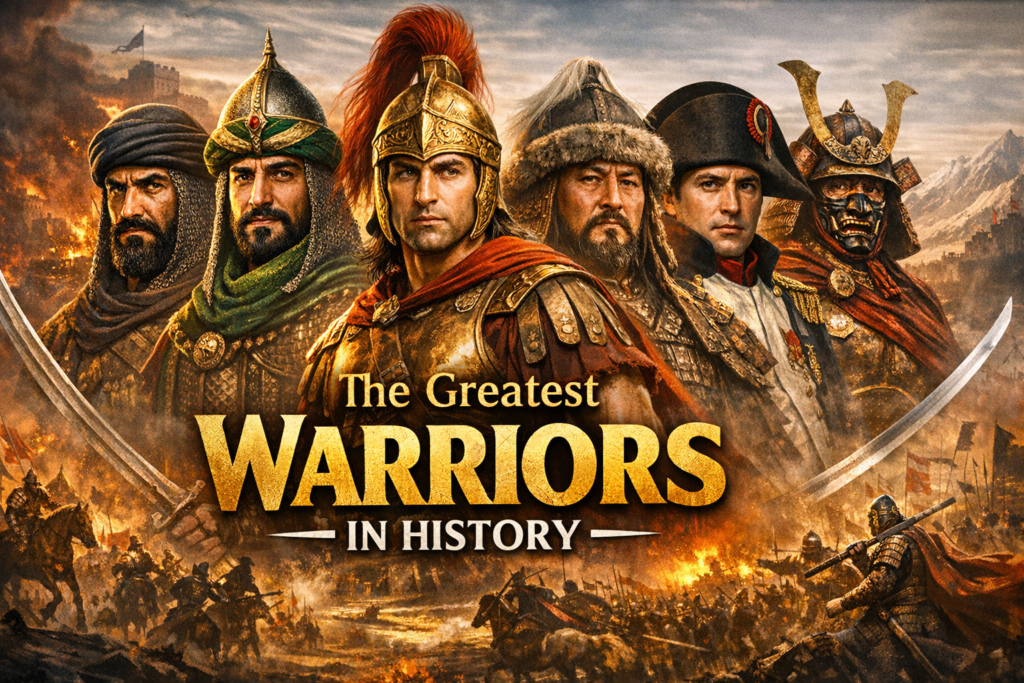

Throughout history, the Arab world produced some of the most brilliant military leaders ever known. These commanders did not only win battles; they reshaped empires, expanded civilizations, and changed the strategic map of entire regions. Their names became symbols of courage, discipline, intelligence, and battlefield mastery.
Military historians often debate rankings and achievements, but there is wide agreement that several Arab commanders stand among the greatest warriors the world has ever seen. Before examining global military legends, it is essential to begin with the warriors who defined Arab military history.
1. Khalid ibn al-Walid – The Sword of God
No discussion of Arab military greatness can begin anywhere except with Khalid ibn al-Walid.
Known as “The Sword of God,” Khalid is widely regarded as one of the greatest battlefield commanders in history. His military genius was demonstrated through a series of rapid campaigns that reshaped the Middle East in the 7th century.
Khalid fought over one hundred battles and is famously believed to have never lost a single one. His tactical flexibility allowed him to command smaller armies against larger and better equipped forces.
One of his most remarkable achievements was the rapid desert march during the Muslim conquest of Syria, where he moved an army across a route considered impossible. This maneuver allowed his forces to surprise Byzantine armies and secure major victories.
At the historic Battle of Yarmouk in 636 CE, Khalid’s strategies defeated a massive Byzantine army and opened the Levant to Muslim control. The battle is still studied in military academies today.
His legacy remains unmatched in Arab military history.
2. Saladin – The Liberator of Jerusalem
Few leaders in history achieved both military greatness and universal respect like Saladin.
Born in Tikrit in present-day Iraq, Saladin rose from a Kurdish military family to become the founder of the Ayyubid dynasty. His leadership unified Muslim forces during the Crusades and transformed the balance of power in the Middle East.
His most famous victory came at the Battle of Hattin in 1187, where his army crushed the Crusader forces. The defeat of the Crusader kingdom led directly to the recapture of Jerusalem.
Saladin’s reputation extended far beyond the Islamic world. Even European chroniclers described him as honorable and merciful compared to many rulers of his time.
His combination of strategy, diplomacy, and leadership secured his place among history’s greatest commanders.
3. Tariq ibn Ziyad – Conqueror of Iberia
Tariq ibn Ziyad led one of the most daring invasions in medieval history.
In 711 CE, Tariq crossed from North Africa into the Iberian Peninsula with a relatively small army. After landing at the location that would later be called Gibraltar (derived from Jabal Tariq, meaning “Mountain of Tariq”), he faced the powerful Visigothic kingdom.
At the decisive Battle of Guadalete, Tariq’s forces defeated the Visigothic king Roderic. The victory opened the Iberian Peninsula to Muslim rule for centuries.
The conquest created Al-Andalus, one of the most advanced civilizations of medieval Europe.
4. Amr ibn al-As – The Conqueror of Egypt
Amr ibn al-As was not only a skilled commander but also a master strategist and diplomat.
In 639 CE he led the Muslim conquest of Egypt, defeating Byzantine forces and capturing the great city of Alexandria.
The campaign culminated in the Battle of Heliopolis (640), where his forces defeated a larger Byzantine army through superior tactics and mobility.
Amr later founded the city of Fustat, which became the first Islamic capital of Egypt and the foundation for the later development of Cairo.
5. Sa’d ibn Abi Waqqas – The Commander Who Defeated the Persian Empire
Sa’d ibn Abi Waqqas led the Muslim armies during one of the most decisive conflicts in Middle Eastern history.
At the Battle of al-Qadisiyyah in 636 CE, his army defeated the powerful Sassanian Persian Empire. The victory led to the collapse of one of the world’s great superpowers at the time.
This battle opened Iraq and Persia to Muslim rule and permanently altered the political map of the region.
The Greatest Warriors in World History
Beyond the Arab world, history records many extraordinary military leaders whose strategies shaped entire civilizations.
These commanders expanded empires, transformed warfare, and introduced innovations still studied today.
Alexander the Great
The Macedonian king created one of the largest empires in the ancient world by the age of 32. His victories over the Persian Empire and campaigns reaching India remain legendary.
Genghis Khan
Founder of the Mongol Empire, Genghis Khan built the largest contiguous land empire in human history through unmatched cavalry tactics and military organization.
Subutai
Often called the greatest general of the Mongol Empire, Subutai planned massive multi-army campaigns across Europe and Asia with extraordinary coordination.
Julius Caesar
Roman general and statesman whose campaigns in Gaul expanded Roman territory dramatically and transformed the Roman Republic.
Napoleon Bonaparte
The French emperor revolutionized modern warfare through speed, maneuver warfare, and mass mobilization. His military campaigns dominated Europe for over a decade.
Hannibal Barca
Carthaginian commander famous for crossing the Alps with elephants during the Second Punic War and defeating Roman armies multiple times.
Sun Tzu
Ancient Chinese strategist and author of the famous military treatise The Art of War, one of the most influential strategy books in history.
Cyrus the Great
Founder of the Persian Empire who united vast territories and built one of the most powerful empires of the ancient world.
Erwin Rommel
The German field marshal known as the “Desert Fox” for his leadership of Axis forces in North Africa during World War II.
George S. Patton
A legendary American general whose aggressive armored warfare tactics helped lead Allied victories in World War II.
Why These Warriors Still Matter Today
Military academies around the world continue to study the campaigns of these commanders. Their strategies, leadership methods, and battlefield innovations shaped the evolution of warfare.
From the lightning maneuvers of Khalid ibn al-Walid to the global conquests of Alexander the Great and the strategic brilliance of Napoleon, these warriors demonstrate that leadership, discipline, and intelligence often outweigh sheer numbers on the battlefield.
Their stories remain powerful reminders that history is often shaped by individuals capable of transforming the course of war.