
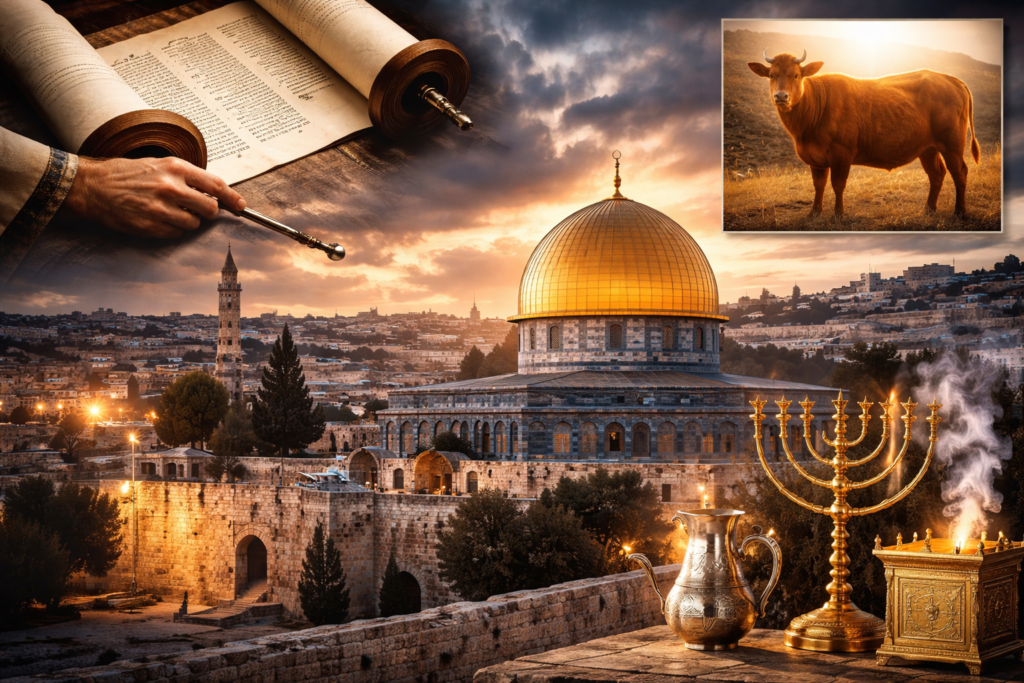

Is Al-Aqsa Mosque at risk of destruction? Explore the truth behind the Third Temple debate, red heifer ritual, and the geopolitical tensions surrounding Jerusalem.
Introduction: Why Is the World Suddenly Talking About Al-Aqsa Again?
What if one of the most sacred places in the world suddenly became the center of a global religious and political storm?
In recent years, discussions about the future of Al-Aqsa Mosque, the idea of the Third Temple, and religious prophecies have increasingly appeared in news reports, social media debates, and political analysis. Some voices claim that plans already exist to destroy the mosque and build the Third Temple of Solomon in its place.
But how much of this is based on fact, and how much is speculation or misunderstanding?
In this article, you will learn:
- The historical and religious background of the Temple Mount and Al-Aqsa Mosque
- The origins of the Third Temple prophecy
- The controversial Red Heifer ritual
- The political realities surrounding Jerusalem
- Whether Al-Aqsa Mosque is actually under imminent threat
Let’s break down the facts.
The Historical Importance of Al-Aqsa Mosque
A Sacred Site for Muslims
Al-Aqsa Mosque is one of the holiest sites in Islam. It is located in Jerusalem, inside the area known as the Haram al-Sharif (the Noble Sanctuary).
For Muslims worldwide, the mosque holds immense spiritual significance:
- It is the third holiest site in Islam, after Mecca and Medina.
- It was the first Qibla (direction of prayer) for Muslims.
- It is closely connected to the Isra and Mi’raj journey of Prophet Muhammad.
Because of its religious importance, any development concerning Al-Aqsa often generates strong reactions across the Muslim world.
The Temple Mount: A Shared and Contested Sacred Space
Jewish Religious Significance
The same location where Al-Aqsa stands today is known in Judaism as the Temple Mount.
According to Jewish tradition:
- The First Temple, built by King Solomon, stood there around the 10th century BCE.
- It was destroyed by the Babylonians in 586 BCE.
- The Second Temple was later constructed and destroyed by the Romans in 70 CE.
Since then, Jewish religious texts have referenced the future rebuilding of a Third Temple.
However, it is important to understand that Judaism itself is divided on this issue.
Three Major Jewish Perspectives
- Religious activists who support rebuilding the Third Temple.
- Traditional Orthodox scholars who believe the Temple should only be rebuilt by divine intervention.
- Secular Jews, who see the Temple as historical rather than a political objective.
The Red Heifer Ritual: Why It Sparks Global Debate
What Is the Red Heifer?
One of the most controversial topics in the Third Temple discussion is the Red Heifer ritual.
In ancient Jewish law described in the Book of Numbers, a completely red cow was required for purification rituals connected to the Temple.
According to tradition:
- The animal must be entirely red with no other colored hairs.
- It is used in a purification ceremony.
- The ashes are used in ritual cleansing.
Some religious groups believe that performing this ritual is a necessary step before rebuilding the Temple.
Why the Red Heifer Became a Modern Controversy
Recently, reports emerged that several red heifers were transported from the United States to Israel for religious research.
This sparked widespread discussion for several reasons:
- Some people interpreted it as preparation for rebuilding the Temple.
- Others saw it as a purely religious or symbolic act.
- Media coverage amplified speculation across social media platforms.
However, there is no official political plan connecting these animals to any government decision about Jerusalem.
Could Al-Aqsa Mosque Actually Be Destroyed?
Political Reality
Despite the rumors circulating online, destroying Al-Aqsa Mosque would have enormous consequences.
Such an action would likely:
- Trigger massive international protests.
- Create severe diplomatic crises.
- Potentially ignite a regional or global conflict.
Because of this, most analysts believe that no government would risk such an extreme move.
The Current Status Quo in Jerusalem
Today, the site operates under a delicate arrangement often referred to as the Status Quo.
Key elements include:
- The Islamic Waqf administers the compound.
- Israel controls security around the site.
- Non-Muslim visitors are allowed but religious practices are restricted.
Maintaining this balance has become crucial for regional stability.
Why These Narratives Spread So Quickly
In the digital age, stories related to religion and geopolitics spread rapidly.
There are several reasons for this:
Emotional Power
Religious sites carry deep emotional meaning for billions of people.
Political Tensions
The Israeli-Palestinian conflict amplifies every development in Jerusalem.
Social Media Algorithms
Content that sparks fear or outrage spreads faster online.
As a result, many claims circulate without proper verification.
The Future of Al-Aqsa and Jerusalem
Jerusalem remains one of the most sensitive cities on Earth.
Several factors will shape its future:
- Diplomatic negotiations
- Regional politics
- Religious sensitivities
- International involvement
The stability of holy sites like Al-Aqsa depends largely on maintaining political restraint and respecting religious traditions.
Conclusion: Between Faith, Politics, and Reality
The discussion about the Third Temple, the Red Heifer ritual, and the future of Al-Aqsa Mosque sits at the intersection of religion, history, and geopolitics.
While certain religious groups speak about rebuilding the Temple, there is currently no verified political plan to destroy Al-Aqsa Mosque.
Understanding the historical context and separating facts from speculation is essential in such a sensitive issue.
Jerusalem has always been a city where faith and politics collide — and its future will depend on careful diplomacy, mutual respect, and global attention.
Call to Action
What do you think about the ongoing debate surrounding the Third Temple and Al-Aqsa Mosque?
Share your thoughts in the comments, and if you found this article informative, consider sharing it with others to encourage thoughtful discussion.