
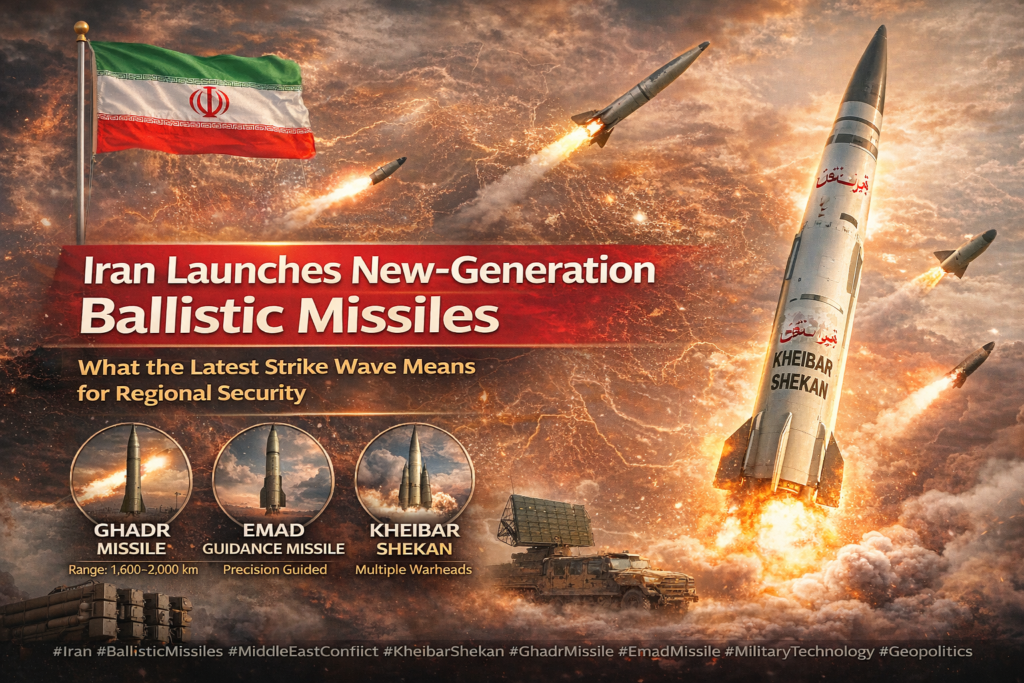

Iranian state media reports the launch of advanced ballistic missiles including Ghadr, Emad, and Kheibar Shekan. Here’s a detailed analysis of the latest missile wave and its geopolitical implications.
Introduction
Could the Middle East be entering a new and more dangerous phase of military escalation?
Recent statements from Islamic Republic of Iran Broadcasting have drawn global attention after Iranian media reported the launch of a new generation of ballistic missiles in one of the latest waves of attacks. According to these reports, the operation included advanced multi-warhead missiles and heavy payload systems designed to increase destructive capability and penetration power against air defense systems.
The announcement comes amid rising tensions across the region, where missile technology, air defense systems, and strategic deterrence play a crucial role in shaping the balance of power.
In this article, we will explore:
- The missiles reportedly used in the latest strike wave
- Their technical capabilities and military significance
- Why heavy warheads were deployed
- Claims about weakening air defense systems
- The broader geopolitical impact of these developments
New-Generation Iranian Missiles in the Latest Strike Wave
Iranian television reports claim that the most recent barrage included advanced ballistic missiles equipped with improved guidance systems and powerful warheads.
Among the missiles mentioned were:
- Ghadr missile
- Emad missile
- Kheibar Shekan missile
These missile systems represent different stages of Iran’s ballistic missile development program and are considered among the most sophisticated weapons currently in its arsenal.
Iran has spent decades expanding its missile capabilities as part of a broader strategy aimed at strengthening deterrence and projecting military power across the region.
Heavy Warheads Deployed in Wave 28
According to Iranian media reports, the 28th wave of missile launches included warheads weighing between:
- 700 kilograms
- Up to 1,000 kilograms (one ton)
Warheads of this size are typically designed for strategic or fortified targets, including:
- Military infrastructure
- Air bases
- Strategic facilities
- Command and control centers
Heavy payload missiles are particularly dangerous because they can cause extensive structural damage even if intercepted late or partially deflected by defense systems.
Military analysts often describe such payloads as high-impact strike weapons, capable of overwhelming or saturating defensive networks when launched in large numbers.
Understanding the Missiles Used
Ghadr Missile
The Ghadr missile is an upgraded version of earlier Shahab missile systems.
Key features include:
- Estimated range of 1,600–2,000 km
- Improved propulsion systems
- Faster launch preparation time
- Greater accuracy compared to earlier models
This missile is designed to reach long-distance strategic targets across the Middle East.
Emad Precision-Guided Missile
The Emad missile represents one of Iran’s first precision-guided ballistic missiles.
Its major improvements include:
- Advanced guidance system
- Improved terminal accuracy
- Maneuverable reentry vehicle
- Greater targeting precision
Precision-guided missiles significantly increase military effectiveness because they reduce the number of missiles needed to strike a target.
Kheibar Shekan Missile
The Kheibar Shekan missile is considered one of the newest missiles in Iran’s arsenal.
The name “Kheibar Shekan” translates roughly to “Khaybar Breaker.”
This missile is notable for several technological features:
- Solid-fuel propulsion
- High maneuverability during flight
- Reduced launch preparation time
- Enhanced ability to evade interception systems
Solid-fuel missiles are especially important because they can be launched much faster than liquid-fuel systems, reducing the risk of being destroyed before launch.
Claims About Air Defense Weakness
Iranian television also claimed that its missiles are now hitting targets more easily due to weaknesses in enemy radar and air defense systems.
However, such claims should be viewed cautiously.
In modern conflicts, information warfare and psychological messaging are often used alongside military operations. Governments sometimes highlight successful strikes while downplaying interception rates or defensive successes.
Nevertheless, analysts agree on one point:
Missile technology is evolving rapidly, and advanced maneuvering systems and multiple warheads can make interception significantly more difficult.
The Strategic Role of Multi-Warhead Missiles
One of the most important aspects mentioned in the report was the use of multi-warhead missile technology.
These systems can deploy:
- Multiple independent warheads
- Decoys designed to confuse radar systems
- Penetration aids
This approach is designed to overwhelm missile defense systems, forcing them to track and intercept multiple objects simultaneously.
In high-intensity conflicts, this strategy is often used to increase the probability that at least some warheads reach their intended targets.
Rising Military Tensions in the Region
The Middle East has long been one of the most militarily complex regions in the world.
Several factors contribute to the rising tensions:
- Advanced missile development
- Expanding military alliances
- Competition for regional influence
- Ongoing geopolitical conflicts
Ballistic missile capabilities are particularly important because they act as strategic deterrence tools, allowing countries to threaten distant targets without deploying conventional forces.
Global Security Concerns
International observers are closely watching developments related to ballistic missile technology.
Concerns include:
- Increased risk of regional escalation
- Greater difficulty intercepting advanced missiles
- Potential arms race in missile defense systems
Several countries have invested heavily in air defense networks designed to intercept ballistic threats, including systems capable of targeting missiles during different phases of flight.
However, as missile technology evolves, defense systems must continuously adapt to new challenges.
The Future of Missile Warfare
The latest reports highlight a broader global trend: missile technology is becoming more advanced, precise, and difficult to intercept.
Future developments may include:
- Hypersonic missiles
- AI-assisted targeting systems
- Improved electronic warfare capabilities
- Advanced multi-warhead technology
These innovations could significantly change how modern conflicts are fought.
Conclusion
The latest missile launches reported by Islamic Republic of Iran Broadcasting illustrate the increasing importance of ballistic missile technology in modern warfare.
Missiles such as the Ghadr missile, Emad missile, and Kheibar Shekan missile demonstrate how military capabilities in the region continue to evolve.
While the exact impact of these strikes remains difficult to verify independently, the developments highlight a key reality: missile warfare is becoming one of the central pillars of modern military strategy.
As tensions remain high, the world will continue watching closely to see how these technological and geopolitical dynamics unfold.
Call to Action
What do you think about the rapid development of missile technology in the Middle East?
Share your opinion and join the discussion.