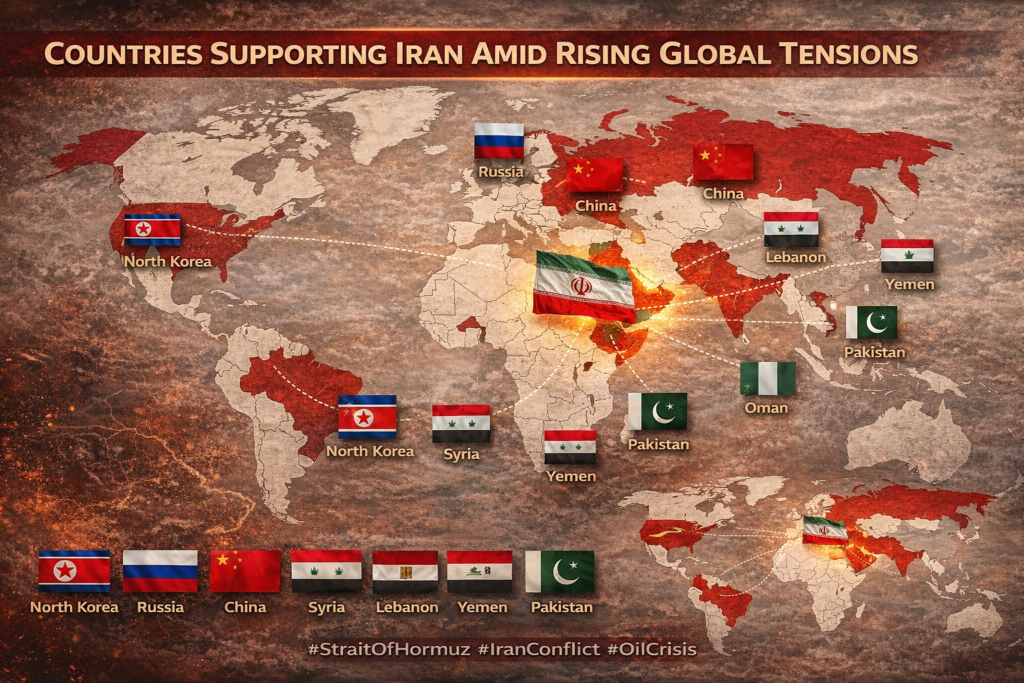

While international alliances are complex and constantly evolving, analysts often point to several countries that have maintained close diplomatic, military, or strategic relations with Tehran in recent years.
Understanding these relationships is essential to grasp how a regional conflict could potentially expand into a broader geopolitical confrontation.
🌐 Key Countries Often Associated with Iran
Several nations have been identified by analysts and international observers as maintaining strong relations with Iran through economic cooperation, military coordination, or shared geopolitical interests.
🇰🇵 North Korea
North Korea and Iran have historically been linked through allegations of missile technology cooperation and shared opposition to Western sanctions.
🇷🇺 Russia
Russia is considered one of Iran’s most important strategic partners, particularly in areas such as military coordination, energy cooperation, and diplomatic support in international forums.
🇨🇳 China
China maintains strong economic ties with Iran, including major energy purchases and long-term infrastructure agreements.
🇸🇾 Syria
Syria has been one of Iran’s closest regional allies, especially during the Syrian conflict where Iranian support played a significant role.
🇱🇧 Lebanon
In Lebanon, Iran has influence through regional political and military relationships that have developed over decades.
🇾🇪 Yemen
The conflict in Yemen has also been linked to broader regional rivalries involving Iran and other Middle Eastern powers.
🇮🇶 Iraq
Iraq maintains complex relations with Iran, including economic ties, religious connections, and political cooperation between various groups.
🇵🇰 Pakistan
Pakistan shares a long border with Iran and has historically balanced relations between regional powers.
🌎 Countries with Diplomatic or Economic Engagement
Other nations maintain relations with Iran primarily through diplomacy, trade, or energy partnerships.
🇧🇷 Brazil
Brazil has historically engaged with Iran through diplomatic dialogue and trade relations.
🇴🇲 Oman
Oman often plays a mediating role between Iran and Western powers and has been involved in several diplomatic negotiations.
🇳🇬 Nigeria
Nigeria maintains diplomatic relations with Iran and participates in broader international cooperation frameworks.
🇪🇬 Egypt
Egypt has historically had complex relations with Iran, with periods of tension and limited diplomatic engagement.
⚠️ The Reality of International Alliances
It is important to understand that international politics rarely operate through simple alliances or fixed blocs.
Countries may cooperate with Iran in some areas while maintaining strong ties with other global powers.
Global diplomacy is shaped by:
- economic interests
- regional security concerns
- political alliances
- strategic competition
As a result, positions can change rapidly depending on the evolving geopolitical environment.
🔎 What Could Happen If Tensions Escalate?
If tensions involving Iran continue to escalate, the international response will likely depend on several factors:
- diplomatic negotiations
- military developments in the region
- global energy market stability
- the involvement of major powers
The Middle East has long been one of the most strategically important regions in global politics, meaning that any escalation there would attract worldwide attention.
🌍 Conclusion
The network of countries maintaining relations with Iran reflects the complexity of modern geopolitics.
Rather than a simple alliance system, today’s international landscape is shaped by overlapping partnerships, economic interests, and strategic calculations.
Understanding these dynamics is essential to analyzing how future regional developments might unfold.