
On day seven of the US-Israeli campaign against Iran, missile strikes, naval tensions, and regional alliances raise global security and energy concerns. Explore the evolving situation.
Introduction: Is the Middle East on the Brink of Full-Scale War?
As the US-Israeli offensive enters its seventh day, the Middle East is witnessing a dramatic escalation. From missile attacks on Tehran to naval alerts in the Gulf, the conflict is testing regional stability and global security frameworks.
In this article, you will uncover:
- The latest developments on the ground and at sea.
- Iran’s military responses and strategic messaging.
- Implications for energy markets and global security.
- Regional and international diplomatic reactions.
Day Seven Overview: Missile Strikes, Naval Alerts, and Civilian Impacts
US-Israeli Air Campaign
- Israeli forces initiated a new wave of airstrikes on Tehran and western Iran targeting military infrastructure.
- Reports indicate the destruction of over 80% of Iran’s air defense installations in key zones.
- The US contributed advanced air assets, including targeted strikes near naval routes and strategic installations.
Iranian Response
- Iran’s Revolutionary Guard launched the 23rd wave of “Al-Waad Al-Sadiq 4” missile operations.
- Naval maneuvers were observed in the Gulf and the Strait of Hormuz, highlighting potential disruption to shipping lanes.
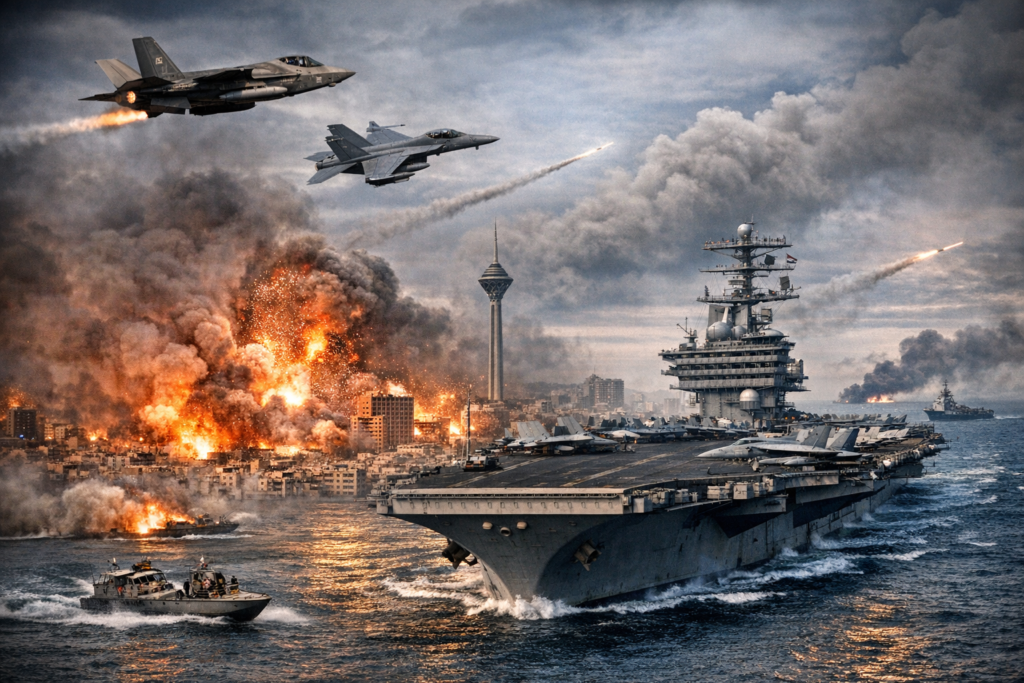
- Iranian forces targeted a US naval vessel, the USS Abraham Lincoln, with drone attacks.
- Civilian infrastructure, including schools, was reportedly affected by strikes, intensifying humanitarian concerns.
Regional Escalation and Middle East Security Dynamics
Gulf States and Energy Security
- Saudi Arabia intercepted four drones targeting the Shaybah oil field.
- Rising oil prices signal market anxiety, with Brent crude hitting levels unseen since July 2024.
- European nations are reassessing energy dependencies amidst regional instability.
Lebanon and Proxy Conflicts
- Hezbollah engaged in cross-border clashes in southern Lebanon, heightening fears of a broader Levant conflict.
- Israeli intelligence reports indicate monitoring of drone and missile activity from Lebanon toward northern Israel.
International Responses
- The UN Secretary-General warned that the conflict may spiral beyond control.
- France deployed the aircraft carrier Charles de Gaulle to the Mediterranean as a deterrent.
- Russia and China were reported monitoring the situation, with potential support to Iran under speculation.
- Saudi-Iran diplomatic channels are reportedly active to prevent further escalation.
Strategic Implications for Global Powers
Military and Security Considerations
- Israel continues targeting high-value military figures and strategic assets in Iran.
- The US emphasizes long-term operational sustainability, including weapons stockpile replenishment.
- Potential Chinese support for Iran raises questions about global alignment and military balance.
Economic and Energy Consequences
- Disruptions to shipping in the Strait of Hormuz and the Red Sea threaten global oil flows.
- Gulf states face unprecedented pressure to secure oil and gas infrastructure.
- International companies and investors are recalibrating risk in the region.
Human and Political Dimensions
- Civilian casualties and disruptions are intensifying public concern in Iran and surrounding countries.
- Political messaging from Tehran emphasizes national resilience and retaliation for attacks.
- Leadership statements, including from US President Trump, suggest a hardline stance on Iran’s surrender and operational targets.
Possible Scenarios Moving Forward
- High-Intensity Escalation: Prolonged conflict with Iran responding with missile strikes, potentially involving regional actors like Hezbollah and proxy militias.
- Limited Conflict: Strikes continue but are contained to strategic military targets, with diplomatic efforts preventing regional spillover.
- De-escalation via Mediation: Regional powers mediate to limit military escalation, while the US and Israel maintain pressure on strategic objectives.
Conclusion: The Uncertain Future of Middle Eastern Stability
Day seven of the US-Israeli offensive against Iran demonstrates the fragility of regional security and the complex interplay of military, economic, and political factors.
Key Takeaways:
- Missile strikes and naval tensions are elevating the risk of broader conflict.
- Iran’s military responses signal resilience and strategic deterrence.
- Global energy markets and regional alliances are highly vulnerable.
- International diplomacy will be critical in preventing an uncontrolled escalation.
Call to Action
How do you see the conflict evolving in the Middle East? Share your insights below, and help others understand the regional stakes.
- Map showing missile strikes and naval movements across the Gulf and Red Sea.
- Image of explosions in western Tehran with caption: “Airstrikes impact Iran’s military infrastructure.”
- Graph of Brent crude prices rising amid Middle East conflict.